

Resource Sharing
In a socialist society, nations retain their geographic stewardship, but use the UN as a forum to coordinate, negotiate, and balance global resource supply with human demand without the use of money or market prices.
How This System Functions
- Geographic Stewardship: Nations do not "own" resources to sell for profit; instead, they act as caretakers. A nation with high lithium deposits or vast fresh water manages those resources on behalf of humanity, ensuring local ecological stability while preparing to share the surplus.
- The UN as a Logistic & Democratic Hub: Rather than a political battleground for trade deals, the United Nations functions as a global coordination forum. It uses data-driven logistics to track global supply (what the Earth can sustainably provide) and match it with human demand (what people need to thrive).
- Needs-Based Allocation (Moneyless): Without prices to ration goods, resources flow based on urgency, sustainability, and human rights. For example, if a region faces a drought, water and infrastructure resources are routed there immediately by global agreement, without the barrier of debt, loans, or financing.
The Systemic Challenges to Resolve
To make a global system like this operational, resource theorists usually point to this major hurdle that needs to be negotiated at the UN level:
- The Economic Calculation Problem: Without market prices to signal scarcity (e.g., a high price showing a resource is running out), the UN would need to rely on massive, real-time scientific data networks. It must calculate the "ecological cost" of moving resources rather than the monetary cost.
Resource allocation relies on voluntary, multilateral coordination driven by transparent data.
- The UN as a Matchmaker, Not an Owner: The UN does not distribute resources. Instead, it hosts a global, open-access ledger where nations log their current resource surpluses (e.g., "We harvested an excess of wheat") and their immediate material deficits (e.g., "We need copper for our electrical grid").
- Peer-to-Peer Material Treaties: Once needs and surpluses are visible on the UN floor, nations negotiate direct, moneyless logistics treaties. Allocation is resolved through collaborative planning rather than centralized command.
- Sovereignty as Stewardship: Nations maintain control over their borders and resources, but their international standing and access to the global pool depend entirely on their willingness to participate transparently in the forum.
🟢 Advantages
- Protects Local Autonomy: By avoiding a centralized global state or "super-trust," local communities and nations retain self-determination over their immediate environments.
- Lower Bureaucratic Weight: The UN doesn't need a massive, planetary apparatus to police, guard, or legally manage physical land across the globe. It only needs to maintain the communication infrastructure and data registries.
- Alignment with Classic Theory: This closely mirrors the socialist concept of a "federation of communes," scaled up to modern international relations.
The Exporter-Only veto
The "Exporter-Only" veto is a specific legal mechanism designed to solve one of the greatest historical flaws in international diplomacy: systemic gridlock.
In current intergovernmental bodies like the UN Security Council, a "universal veto" allows a single powerful nation to block an action anywhere in the world, even if they are not directly involved. If applied to a global resource ledger, a universal veto would allow rival nations to constantly block each other's supply chains, using the AI's logistics as a weapon for economic warfare.
The Exporter-Only veto restricts this power entirely to the boundaries of national sovereignty.
How It Works
It operates on a single, strict principle: A nation can only say "no" to the movement of its own physical resources.
-
The Right of Refusal: If the AI Engine calculates that Nation A should export 10,000 tons of wheat to Nation B to fulfill a Tier 2 infrastructure deficit, Nation A has the absolute right to veto that specific treaty. The wheat stays in Nation A.
-
The Prohibition of Interference: Nation C (a geopolitical rival of Nation B) has no say in the matter. Because Nation C is not the one exporting the wheat, the system does not grant them a veto over the transaction. They cannot embargo Nation B through the UN forum.
Scenario: The AI Proposes a Logistics Treaty
Assume the AI detects a Tier 2 energy grid deficit in India and calculates that the optimal source of copper to fill this deficit is from mines in Chile.
Actor Veto power in this scenario Rationale
Chile Has Veto The copper originates within their sovereign borders. They can decline the export.
India No Veto They are the receiving nation; they submitted the deficit request.
China No Veto They are a third party. They cannot block Chile from supplying India.
USA No Veto They are a third party. They cannot block the treaty.
Why This is Crucial for Institutional Viability
If the UN's purpose is to prevent conflict, this specific rule is the linchpin that makes the entire non-market framework possible.
1. It Guarantees Sovereignty (The Hook for Membership): Nations are highly protective of their natural wealth. No sovereign state will join an organization if they believe an AI algorithm, or a foreign voting bloc, can legally force them to empty their own mines or silos. The Exporter-Only veto serves as an ironclad guarantee that participation in the ledger will never result in forced extraction.
2. It Eliminates Proxy Embargoes: By stripping third parties of their ability to interfere, you remove the ability for superpowers to starve smaller nations through diplomatic maneuvering. Sharing becomes strictly peer-to-peer, coordinated by the AI, and immune to outside sabotage.
3. It Enables Algorithmic Resilience: When a universal veto is used, the entire system stops to debate. When an Exporter-Only veto is used, the AI simply registers that specific supply node as "offline" for that transaction. The Engine instantly recalculates the global logistics map to find the second-best optimal route to supply India with copper (perhaps from Australia or Zambia), ensuring that global supply chains never freeze.
Resource Acquisition
Acquiring resources in this framework follows a strict six-stage pipeline that transitions a material deficit from initial logging to automated ledger balancing.
Country A submits a formal material request to the open-access UN ledger, categorizing the need into Tier 1 (Global Emergency), Tier 2 (Steady-State Infrastructure), or Tier 3 (Luxury/Non-Emergency).
2. Telemetry Audit & Verification: Processed by the AI Engine.
The open-source AI evaluates Country A's request against real-time sensor networks, agricultural yields, and industrial telemetry. This mathematically verifies that the deficit is genuine and prevents stockpile inflation or false reporting.
3. Algorithmic Matchmaking & Treaty Draft: Optimizing logistics.
The AI scans global surplus registries and identifies Country B as the optimal supplier based on verified material reserves, proximity, and minimal energetic transport costs. It automatically generates a draft moneyless logistics treaty.
4. Sovereign Review & Veto Window: Exercised by Country B.
Country B receives the draft treaty for review. As the producing nation, Country B holds the Exporter-Only Veto and can decline the export if the materials are required for immediate domestic needs. Third-party nations have no legal standing to block or embargo the transaction.
If Country B executes a veto, the AI instantly recalculates and re-routes the request to a secondary surplus nation.
5. Ratification & Physical Dispatch: Moneyless execution.
Upon Country B's confirmation (or automated release during a verified Tier 1 crisis), the peer-to-peer treaty is finalized. Transport assets are dispatched according to the AI's calculated logistics and shipping plan.
6. Receipt & Real-Time Ledger Reconciliation: Final balancing.
When the materials arrive at Country A's ports or border terminals, cryptographic sensor nodes verify delivery. The UN ledger automatically updates both nations' inventory levels in real time.
Structural Comparison
StageStandard Market System UN Non-Market Framework
Allocation Driver Purchasing power & market prices Verified material need & open data
Supplier Selection Private bidding & profit margins Algorithmic logistics & energy optimization
Sovereignty Safeguard Export tariffs & trade sanctions Exporter-Only Veto
Transaction Currency Financial reserves & debt Moneyless peer-to-peer treaties
UN Frameworks That Could Act as an RBE Ledger
To transition to a true resource-based ledger, the UN would have to pivot away from Umoja and rely instead on its existing environmental accounting frameworks:
- SEEA (System of Environmental-Economic Accounting): This is an official UN statistical standard. It measures ecosystems, water resources, minerals, and energy in physical units (e.g., cubic metres, tonnes) alongside economic data. It is the closest existing framework to an RBE ledger.
- UN-ECE Resource Management System (UNRMS): A global system designed to manage anthropogenic and natural resources sustainably. It focuses on resource availability and life-cycle tracking rather than purely financial returns.
- UN Blockchain Initiatives: Several UN agencies (like the UN Innovation Network) pilot blockchain ledgers to track supply chains, carbon credits, and environmental resources transparently without relying entirely on traditional fiat metrics.
To scale these into a functional RBE, they would need to be coupled with a global network of IoT sensors and AI to automate the dynamic allocation of resources without using money.
What is a treaty?
A treaty is a formal, legally binding written agreement between sovereign countries or international groups. Governed by international law, treaties set clear rules for how nations handle trade, peace, borders, or human rights. Once signed and approved, countries must follow the rules they promised to keep.
Types of Treaties
- Bilateral: An agreement made between two countries.
- Multilateral: An agreement involving three or more countries.
- Other names: Often called conventions, pacts, protocols, or accords.
How Treaties Work
- Negotiation: Leaders or diplomats write the terms of the agreement.
- Signing: Officials sign the official document.
- Ratification: Each government formally approves the deal through its own domestic laws (such as a vote in parliament or the senate).
- Enforcement: The rules become binding international law for all groups that signed.
Carbon Budgets Across Tiers
In this framework, yes. The AI engine is hard-coded to evaluate national carbon budgets and broader planetary boundaries alongside physical supply levels.
When Country A requests resources, the AI does not just check if Country B has excess supply; it calculates the embodied carbon cost of extracting, refining, and transporting that material, comparing it against Country A's real-time ecological allocation.
How the AI Enforces Carbon Budgets Across Tiers
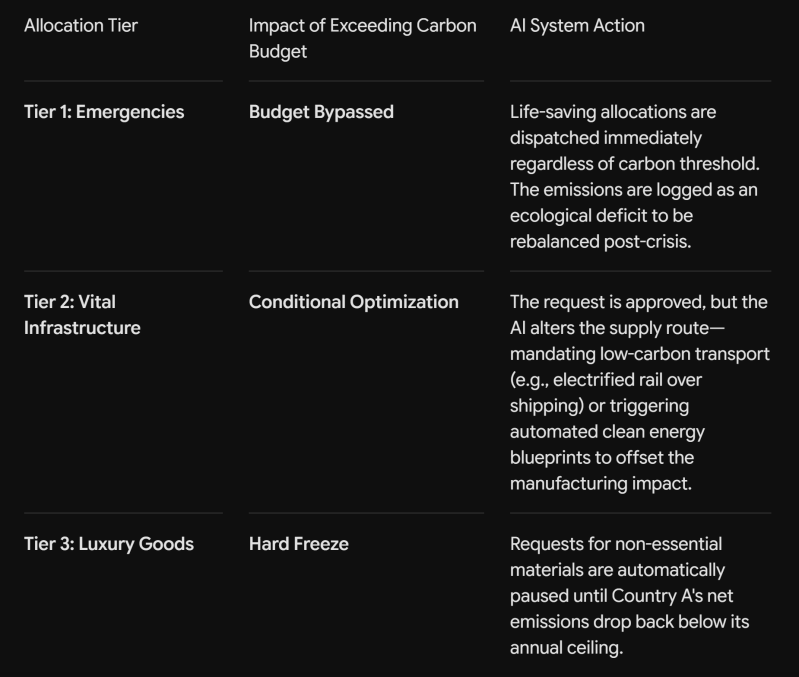
1. Accounting for Embedded Carbon Every material logged in the global registry carries a carbon coefficient. If Country A requests 50,000 tons of steel, the AI factors in the specific energy mix of Country B's foundry, the fuel requirement of transit, and the processing energy needed upon arrival.
2. Calculating Ecological Equity To prevent historically industrialized nations from maintaining an unfair advantage, the baseline carbon budgets programmed into the AI are governed by per-capita equity and historic climate debt protocols. Developing states receive higher relative emission ceilings for Tier 2 infrastructure build-outs, while hyper-industrialized nations operate under tighter reduction curves.
3. Automated Substitution Logic If Country A is on the verge of breaching its carbon limit, the AI automatically proposes material alternatives. For example, if traditional concrete production would exceed Country A's carbon cap, the AI rewrites the treaty draft to supply cross-laminated timber or low-carbon geopolymer cement instead.
Manual Allocation Phase
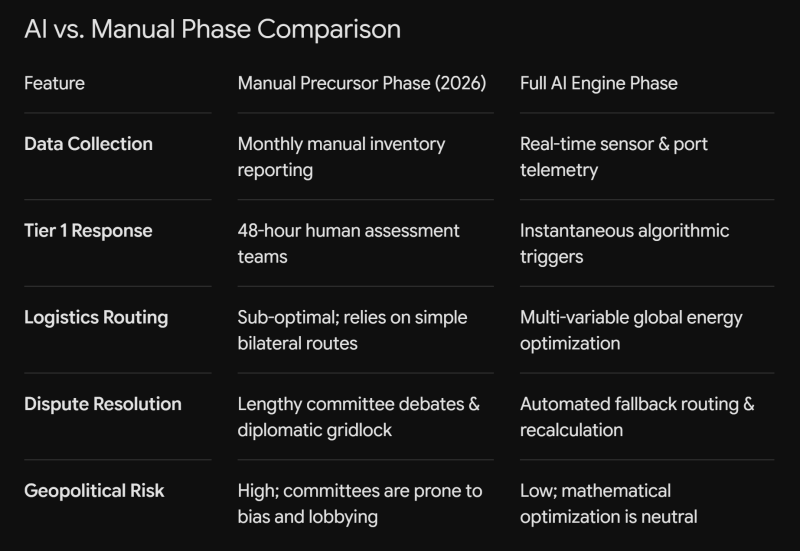
Before the AI goes live, the UN must rely on human-driven bureaucratic mechanisms. This approach mirrors how current international disaster response and humanitarian logistics operate today, but adapted for our moneyless, peer-to-peer framework.
Here is how we structure the manual prototype to handle the three allocation tiers:
The Manual Allocation Prototype
Without algorithmic matchmaking and real-time telemetry, the organization acts as a giant, diplomatic clearinghouse.
-
The "Static" Ledger: Instead of an automated data stream, nations submit manual inventory reports (e.g., monthly spreadsheets of verified surpluses and deficits) to a central UN Secretariat.
-
The Matchmaking Committees: We utilize a structure similar to the current UN "Cluster Approach." Dedicated human committees—specialized in sectors like Health, Agriculture, and Energy—review the static ledger and manually connect Country A’s deficit with Country B’s surplus.
-
The Pledging Floor: For acute shortages, the UN hosts real-time pledging conferences. A country declares a Tier 1 or Tier 2 deficit, and producing nations manually volunteer to fulfill it, drafting bilateral treaties on the floor.
How the Tiers Operate Without AI
Tier 1: Global Emergencies (The 48-Hour Protocol)
Without AI to trigger instant dispatch, you must rely on rapid human assessment. You can model this on the existing United Nations Disaster Assessment and Coordination (UNDAC) system.
-
The Mechanism: When a crisis hits, human inspection teams deploy within 48 hours to verify the deficit on the ground. They report back to the Secretariat, which then manually requests emergency stock from pre-approved surplus nations.
-
The Cost: What an AI could authorize in milliseconds takes days. In a severe crisis, this latency costs lives.
Tier 2: Vital Infrastructure (Annual Treaty Cycles)
Managing continuous, steady-state supply lines manually is too complex for real-time adjustments.
-
The Mechanism: Tier 2 allocations are handled through lengthy, annual diplomatic summits. Nations negotiate long-term, static logistics treaties (e.g., "We will send 10,000 tons of lithium per month for the next two years in exchange for your clean energy surplus").
-
The Cost: This brings back the classic "Economic Calculation Problem." If a supply chain breaks mid-year (e.g., a mine floods), human committees cannot instantly recalculate global shipping routes. The system suffers from chronic bottlenecks and bullwhip effects.
Tier 3: Luxury Goods (The Bureaucratic Freeze)
-
The Mechanism: Without AI, managing planetary logistics for non-essential premium goods is mathematically impossible for a human committee to optimize without market prices.
-
The Cost: During the manual phase, Tier 3 must be largely suspended or left to the remnants of traditional market trading until the AI Engine comes online to handle the computational load.
Currently, the United Nations maintains extensive records and statistical databases covering member states' natural resources, environment statistics, energy reserves, and material use, managed through portals like UNdata and the UN Statistics Division.
Key UN Databases for Natural Resources
- Environment Statistics (UNSD): Collects country-level data via regular questionnaires on water resources, land use, and subsoil assets.
- Energy Statistics Database: Tracks production, trade, and consumption of coal, oil, natural gas, and electricity.
- UNCTADstat: Provides data on trade and dependence on primary commodities and natural resource extraction.
- World Database on Protected Areas: Managed by the UN Environment Programme (UNEP-WCMC), tracking terrestrial and marine natural preservation.