

Carbon Budget
In our moneyless economy, where carbon is the primary currency and limiting metric, managing the national carbon allocation replaces traditional fiscal budgeting.
With an expected emission of 690 MtCO₂ for 2026, the government staying within its carbon budget means the nation is successfully managing its "environmental ledger" without bankrupting its climate targets.
The Dynamics of a Carbon-Budgeted Economy
In a resource-based or moneyless economy that operates strictly under ecological caps, economic planning shifts from financial capital to physical resource limits:
- Carbon as the Deficit Limit: Instead of a fiscal deficit (spending more money than collected), the government tracks a carbon deficit. Staying under budget means total infrastructure construction, energy generation, and public consumption have stayed within the safely allocated carbon allowance.
- Infrastructure Investment: Building roads, upgrading grids, or constructing buildings requires an upfront "investment" of embodied carbon (the emissions generated by creating steel, concrete, etc.). Since the budget has not been exceeded, the government has successfully prioritized low-carbon materials or offset these projects through carbon-negative practices like reforestation or direct air capture.
- Resource Allocation: Every sector of the economy receives a strict carbon quota. The 690 MtCO₂ figure acts as the national "gross ceiling." Remaining under it indicates that industrial output and logistics were efficiently optimized.
How the Infrastructure Gap Changes
Without financial constraints, the only bottlenecks to upgrading a nation's infrastructure are physical resources, labor, and the carbon cap. Because the government has not exceeded its budget, it still possesses "carbon runway" to deploy further public works before the end of 2026, provided it doesn't cross the 690 MtCO₂ threshold.
The Environmental Ledger
In this post-monetary economy, the environmental ledger replaces the traditional financial accounting system (like central bank ledgers or national treasuries). Instead of tracking cash flow, inflation, and debt, it tracks the physical and ecological cost of everything the nation produces, consumes, and maintains.
The environmental ledger comprehensively records:
1. Embodied Carbon Costs
- Material Extraction: The exact carbon cost to harvest raw resources (e.g., logging wood, mining iron ore).
- Manufacturing and Processing: The emissions generated by processing those resources into usable products or building components (e.g., manufacturing steel, firing concrete).
- Supply Chain and Distribution: The transit footprint of moving goods from production hubs to local access centers.
2. Infrastructure Lifecycle Debts
- Upfront Construction Footprint: The initial carbon budget "spent" to build roads, public housing, water systems, or energy grids.
- Maintenance and Operation: The ongoing carbon required to keep public services running, repaired, and operational over their lifespan.
3. Resource Availability & Limits
- National Carbon Ceiling: The overall planetary boundary or emission limit assigned to the nation (e.g., the 690 MtCO₂ ceiling for 2026).
- Sector Quotas: How much of that 690 MtCO₂ budget is divided among sectors like housing, agriculture, public transport, and medicine.
4. Regeneration and Offsets
- Carbon Sinks: The negative emissions or "deposits" credited to the ledger through active ecological regeneration, such as reforestation, peatland restoration, or direct air capture technologies.
The United Nations Role
Currently, the United Nations does not directly set or enforce global carbon budgets and goals. Instead, the UN acts as an international facilitator and scientific auditor. Under the UN-administered Paris Agreement, individual nations are entirely responsible for setting their own climate targets. The UN's role is to calculate what is scientifically required to avoid climate disaster and track how far short countries are falling.
The UN manages these global goals through a distinct structure:
1. The Global "Goal" is a Temperature, Not a Carbon Budget
The UN does not mandate a specific maximum number of tonnes of carbon the world can emit. Instead, through the UN Framework Convention on Climate Change (UNFCCC), member states collectively agreed to a temperature-based goal: limiting global warming to well below 2°C, while actively pursuing efforts to cap it at 1.5°C.
2. Countries Set Their Own "Budgets" (NDCs)
Because the UN is not a world government, it cannot dictate emission caps to sovereign nations. Instead, the system relies on Nationally Determined Contributions (NDCs).
- Every five years, individual governments must submit their own voluntary emission reduction plans to the UN.
- It is up to domestic governments to translate these promises into legally binding local laws, such as the UK's multi-year Carbon Budgets.
3. The UN's Role: The Scientific "Auditor"
While the UN cannot enforce limits, its specialized bodies provide the math that everyone uses:
- The IPCC Defines the Remaining Carbon Budget: The UN's Intergovernmental Panel on Climate Change (IPCC) calculates the physics. For instance, scientific models indicate that from 2026, the remaining global carbon budget to maintain a 50% chance of staying under 1.5°C is roughly 170 billion tonnes (GtCO2)—which equals about four years of current global emissions.
- The UNEP Tracks the "Emissions Gap": The UN Environment Programme (UNEP) publishes the annual Emissions Gap Report. This report measures the massive divide between what countries have promised to cut and what is actually needed to hit the 1.5°C target. For instance, current data shows that countries must collectively slice 55% off annual greenhouse gas emissions by 2035 to keep the 1.5°C pathway alive.
NOTICE:
Currently, governments do not track the precise physical and ecological cost of everything produced, consumed, and maintained, but they do track these impacts at an aggregate, macroeconomic level using specialized accounting systems.
While a government does not log the exact ecological lifecycle footprint of every individual shirt, laptop, or building maintenance project, it tracks the overall "social metabolism" of the nation using standardized scientific and economic frameworks.
Why isn't everything tracked perfectly?
Tracking the exact ecological cost of every single micro-transaction is currently impossible due to data fragmentation. Data on global supply chains is heavily obscured by international trade, and corporations are generally not required to report the granular, itemized lifecycle data of every product to the state. Government tracking relies heavily on top-down economic modeling and statistical sampling rather than a literal ledger of every item.
How Governments Are Closing the Gap
Governments are not simply accepting this disadvantage; they are actively transitioning toward much more granular tracking. For example, the European Union has pioneered Digital Product Passports (DPPs). These digital ledgers require manufacturers to track and open up data on the exact material composition, carbon footprint, and recyclability of individual products (starting with electronics, batteries, and textiles) so that they can be precisely monitored from creation to disposal.
Digital Passports
In a moneyless economy—whether organized as a resource-based economy, a decentralized planning system, or a mutual-aid network—Digital Product Passports (DPPs) would transform from a tool for corporate regulation into the core operating system for resource management.
Without prices to signal scarcity or value, a moneyless economy relies entirely on physical and ecological metrics to decide what can be produced, shared, and recycled. DPPs provide the exact data needed to make those decisions.
Here is how Digital Product Passports would function as the foundation of a moneyless society:
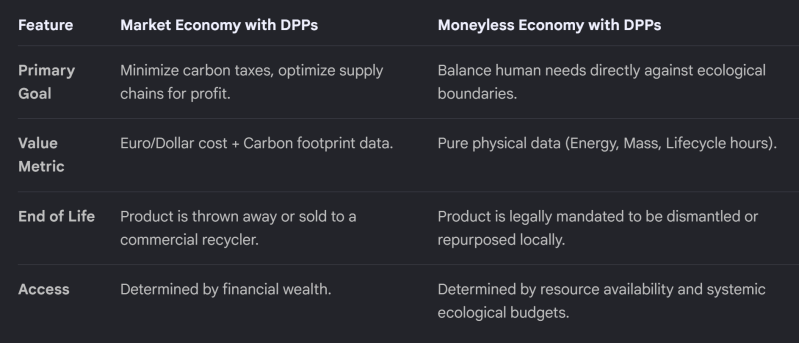
1. Replacing Currency with "Ecological Budgets"
In a moneyless system, you cannot use prices to limit consumption. Instead, DPPs allow the community or system to track the true ecological cost of an item against the planet's carrying capacity.
- Thermodynamic Costing: Every item's passport would display its total cost in energy (kilowatt-hours), water (litres), raw materials (grams), and carbon output.
- Resource Allocation: Instead of checking a bank account, an automated distribution system (or a community council) would check the item's DPP against regional and global ecological thresholds before authorizing its production. If a product's DPP shows it exceeds the allowable biophysical boundary, it simply isn't produced.
2. Eliminating Waste via Perfect Circularity
Without money, there is no profit motive to create cheap, disposable goods (planned obsolescence). DPPs would act as a permanent identity tag ensuring everything remains a resource.
- The "Return to Sender" Protocol: When a device (like a laptop) reaches the end of its use, its DPP dictates exactly where it must go. It guides automated recycling systems or local makerspaces on how to safely disassemble it down to the raw elements.
- Component Reusability: If a washing machine breaks, a technician scans the DPP to see the exact blueprint, manufacturing date, and stress tolerances of the internal parts. They can easily extract still-functioning components to build something else, keeping materials out of landfills permanently.
3. Transparent Decentralized Planning
Moneyless economies often face the criticism that they cannot efficiently match supply and demand without market prices. DPPs solve this by creating a real-time, transparent inventory of the entire world's physical assets.
- Dynamic Scarcity Tracking: Because every product, building material, and machine has a live passport, a decentralized network can instantly calculate exactly how much steel, copper, or treated timber is currently bound up in active use, how much is in storage, and how much is being recycled.
- Automated Sharing Networks: A DPP can track an item's utilization. If a tractor or a 3D printer has a passport showing it has been idle for a week, the system can automatically flag it as available for another community to use.
4. Consumer Access Based on Durability and Care
In a moneyless system, access to goods replaces ownership. DPPs would shift the focus to how well resources are maintained.
- A Ledger of Care: A product’s passport would log its maintenance history. If a user takes good care of a piece of equipment, repairing it when prompted by the DPP’s health diagnostics, that history is recorded.
- Material Stewardship: Instead of "buying" a high-impact item, individuals act as temporary stewards. The DPP ensures that the person returning the item is accountable for its physical condition, ensuring high-quality resources are preserved for the next person.
The Moneyless Supply Chain (A Direct Comparison)
UK Carbon Budget
UK carbon budgets are legally binding, 5-year caps on the nation's total greenhouse gas emissions, designed as stepping stones to reach Net Zero by 2050. Set 12 years in advance, these targets require absolute emissions reductions compared to 1990 levels.
Current and Future Budgets
To date, the government has legislated six carbon budgets running up to 2037. The seventh budget, covering the period up to 2042, is currently being finalized

Recent Progress & Delivery
The UK is the first major economy to halve its emissions, having cut them by 54% between 1990 and 2024.
- Delivery Plan: The government has published an updated Carbon Budget plan. It outlines the policies and proposals to achieve emissions reductions across the power, transport, and heating sectors.
- Advisory Body: The independent Climate Change Committee (CCC) provides continuous scientific and economic advice on establishing and meeting these budgets
Technological Solutions: To stay within these budgets without slashing standards of living, governments rely on demand-reduction strategies and carbon capture technologies.
Demand-reduction strategies are policies and actions designed to lower the consumption of energy, materials, and carbon-intensive goods. Instead of trying to make fossil fuels cleaner, these strategies focus on preventing energy waste at the source.
They are critical because clean energy supply cannot scale fast enough on its own to meet climate goals.
The Three Core Pillars (Avoid-Shift-Improve)
- Avoid: Eliminating unnecessary energy use completely. Examples include working from home to eliminate commutes or designing walkable neighborhoods where driving is not required.
- Shift: Moving from high-carbon options to low-carbon alternatives. Examples include switching from short-haul flights to trains, or using public transport instead of personal cars.
- Improve: Increasing the energy efficiency of existing products and buildings. Examples include upgrading home insulation, installing heat pumps, or using smart thermostats to optimise heating.
Key Benefits
- Relieves Supply Pressure: Lowering demand reduces the total number of wind turbines, solar panels, and batteries that a society needs to build.
- Enhances Energy Security: Consuming less energy makes a nation less vulnerable to international fuel shortages and price spikes.
- Lowers System Costs: Reducing energy waste reduces the need for expensive upgrades to the electricity grid.
Carbon capture technology is a set of methods used to trap carbon dioxide CO2 emissions before or after they enter the atmosphere, preventing them from contributing to climate change.
Unlike demand-reduction strategies that stop energy use at the source, carbon capture deals with emissions that are harder to avoid, such as those from heavy industry.
Key Challenges
- High Cost: Building and running capture facilities requires vast amounts of energy and capital.
- Scale Limits: Current facilities only capture a tiny fraction of global annual emissions.
- Permanence: Underground storage sites must be carefully monitored to guarantee no gas leaks back into the atmosphere over centuries.
Socialist Plan to Phase Out Emissions Far Faster Than a Market Economy...
We plan to carry out a strategic, rapid reduction of non-essential sectors. Since we are not constrained by the necessity for economic growth, we will significantly accelerate the phase-out of emissions by taking immediate and decisive actions:
1. Banning Non-Essential Production: Instantly halting the production of luxury goods, advertising, and planned obsolescence tech, redirecting all remaining carbon directly to human survival.
2. Rationing the Remaining Carbon Budget: Allocating the final 400 billion tonnes of global carbon allowance strictly to emergency services, food logistics, and building renewable infrastructure.
3. Decentralising Production: Shifting to localized agriculture and manufacturing to eliminate the massive carbon footprint of global shipping networks.