

Economic Calculation Problem
We solved the economic calculation problem by replacing a flawed financial metric (money) with an objective thermodynamic metric (physical and ecological constraints).
In the old capitalist and centrally planned models, the calculation problem existed because human planners or market systems tried to assign subjective monetary prices to finite natural resources. This led to ecocide and systemic inequality because prices never reflected the true physical cost of resource destruction.
We bypassed this entire dilemma by treating the global economy not as a financial market, but as a closed-loop thermodynamic system managed across three distinct layers.
🔎 1. The Real-Time Sensing Layer (Data Capture)
We eliminated the need for speculative market "price signals" by building a planet-wide digital nervous system. The UN Planetary Boundaries Logistics Bureau monitors the exact state of the Earth using an automated, decentralized network:
- IoT & Satellite Telemetry: Remote sensing satellites, ocean buoys, and river-monitoring IoT arrays track real-time changes in the 9 planetary boundaries (such as soil nitrogen saturation, freshwater tables, and atmospheric aerosol optical depth).
- The Physical Ledger: Instead of tracking bank balances, our global database tracks physical volumes—cubic kilometres of water, metric tons of topsoil, and kilograms of embodied carbon.
2. The Multi-Dimensional Cost Matrix (Algorithmic Calculation)
In this system, the "cost" of any human activity is no longer a single number (like dollars). It is a matrix of physical inputs and ecological impacts mapped directly against localized carrying capacities.
When a community proposes an activity—such as manufacturing clean energy infrastructure or constructing a housing block—the automated logistics web runs a Life-Cycle Assessment (LCA). It instantly calculates the project's exact physical footprint:
- Dynamic Local Coefficients: The system applies higher physical weights based on regional scarcity. Extracting 10,000 litres of water in a drought-prone zone carries an algorithmically massive "cost" to the local boundary ledger, whereas extracting it in a water-abundant zone carries near-zero friction.
- Non-Fungible Boundaries: Because boundaries are non-fungible, the algorithm cannot use carbon offsets to justify ecocide. If a project breaches even one localized ecological ceiling (e.g., land-system change that threatens an endangered species), the system flags it as physically impossible, instantly halting material routing.
🚚 3. Direct Resource Routing (Moneyless Logistics)
Once a project is cleared within the physical matrix, the logistics web coordinates resource distribution purely based on human need and ecological feasibility.
- Algorithmic Triage: Allocation operates on an absolute priority ladder derived from expanded human rights charters. Essential life-support infrastructure (food distribution, emergency healthcare, ecological restoration) is automatically assigned first-tier priority to use available physical capacities.
- Material Interoperability: If a specific resource hits a physical bottleneck (e.g., a regional biosphere boundary restricts further extraction of a certain metal), the logistical network automatically recalculates. It searches the global material database to route alternative, lower-impact materials (like bio-composites or mass timber) to complete the task without stalling human flourishing.
By turning the economic calculation problem into a problem of data-driven physics and engineering logistics, we ensure that human society expands or contracts precisely in lockstep with the living boundaries of the planet.
To integrate a broader Planetary Boundaries framework into a physics-based currency, the UN must transition from a single-variable carbon metric to a multi-dimensional thermodynamic accounting unit.
Instead of tracking carbon in isolation, every resource, product, and human activity is measured by its consumption of the Earth's total carrying capacity.
The Holistic Accounting Unit: "Eco-Exergy" or "Biocapacity Points"
To prevent a system where society optimizes for carbon while destroying biodiversity or depleting fresh water, the UN must establish a unified metric. In ecological economics, this is often conceptualised as Exergy (available energy used and degraded) or Global Hectares of Biocapacity.
Every activity draws down a single, composite "Ecological Budget" broken into the 9 planetary boundaries:
How the UN Integrates the Boundaries
The UN Global Carbon Council would expand into a Planetary Boundaries Logistics Bureau, regulating nine distinct physical ledgers simultaneously:
1. Dynamic Boundary Weighting (The Matrix Cost)
The "cost" of extracting a resource or manufacturing a product becomes a dynamic matrix. If a nation manufactures a product using clean solar energy, its Carbon cost is near zero. However, if that manufacturing process requires massive amounts of fresh water in a drought-prone region, its Freshwater cost spikes dramatically.
2. Localised Boundary Coefficients
The UN would assign regional weights to physical costs based on local vulnerability.
- In a water-abundant region: The physical cost of using 1,000 litres of water is low.
- In an arid region: The physical cost of using those same 1,000 litres is exponentially high, automatically blocking non-essential water-heavy projects via the automated logistics web.
3. Strict Non-Fungibility (No "Offsets")
Unlike capitalist carbon credits—where a company can emit carbon and claim to "offset" it by planting trees elsewhere—a true physics-based system enforces non-fungibility. You cannot "trade" a deficit in Biosphere Integrity (destroying a wetland) for a surplus in Carbon (installing solar panels). Each boundary has a hard, independent ceiling that cannot be breached.
The 9-Boundary Physics Ledger
When a nation proposes an infrastructure project to the UN forum, the logistical calculation tracks metrics across the entire Earth system:
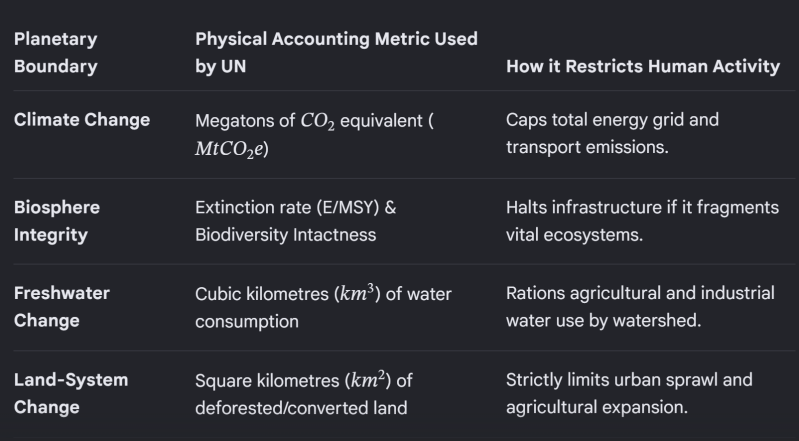
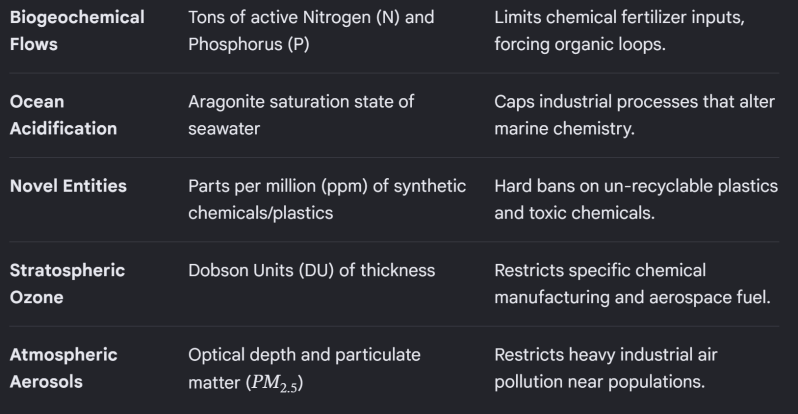
Here is how a Direct Access Resource Abundance System functions when constrained by carbon costs and physical planetary limits:
Ecological Accounting replaces Monetary Budgets
1. Instead of tracking financial capital, the system tracks ecological metrics:
- Carbon Budgets: Every product, service, and infrastructure project is assigned a real-time carbon cost (from raw material extraction to disposal).
- Planetary Boundaries: The allocation mechanism respects physical constraints like freshwater availability, ocean acidification, biodiversity loss, and land use.
- Dynamic Pre-Allocation: Algorithms calculate what resources can be sustainably harvested and processed annually, ensuring total production never breaches these ecological red lines.
2. Algorithmic Distribution & Direct Access
Once the safe operating envelope of the planet is calculated, resources are provisioned directly:
- Automation-Driven Logistics: Automated networks distribute goods and manage infrastructure based on local demographic needs and physical proximity.
- No Price Signals: Because resources are pre-allocated within safe ecological limits, price tags and money are irrelevant. Access is dictated by availability and sustainability metrics rather than purchasing power.
- Needs-Based Optimization: The system prioritizes essential human needs (housing, healthcare, clean energy, nutrition) within the strict carbon budget before allocating resources to non-essential goods.
3. Shift from Ownership to Access
To maximize efficiency under physical constraints, the system heavily relies on a shared infrastructure:
- The Access Model: Since items have a physical and carbon footprint, hoarding is prevented by designing goods for maximum durability, reuse, and shared access.
- Circular Resource Loops: Products are explicitly designed to be easily disassembled and completely recycled back into the production pipeline, ensuring the "physical constraints" loop is completely closed.
The Structural Output
By integrating all nine boundaries, the Economic Calculation Problem is solved through an ecological closed-loop dashboard.
If a nation wants to build a new housing complex, the government doesn't ask "Do we have the money?" Instead, the system automatically checks the local and global ledgers: Do we have the carbon budget for the steel? Do we have the freshwater capacity for the plumbing? Will the physical footprint disrupt local biodiversity? If any boundary reads "red," the project cannot be authorized until the engineering is redesigned to fit within the physical constraints of the planet.
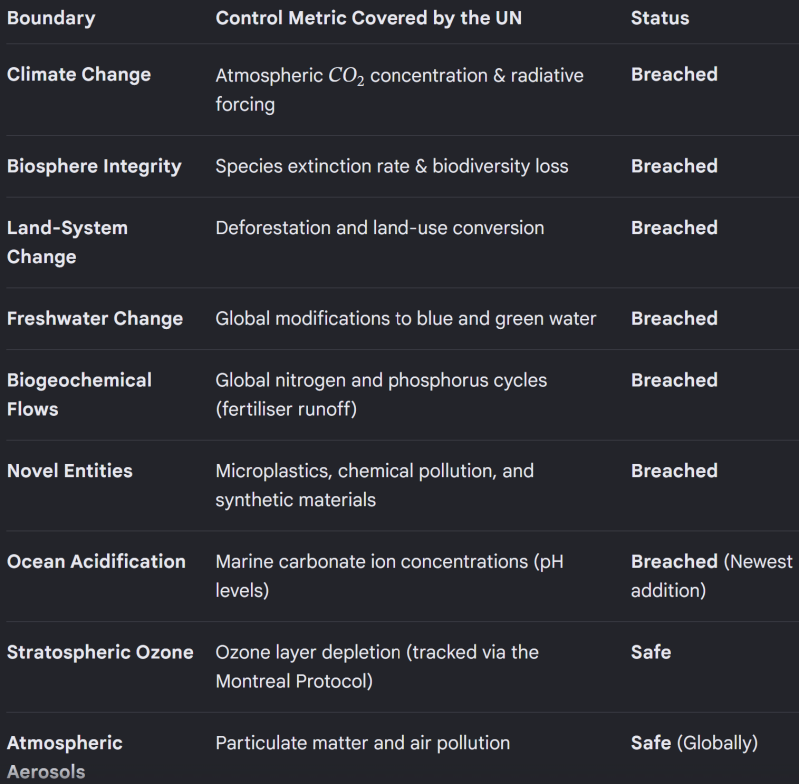
Current Status of the Boundaries
The Planetary Boundaries framework is an independent scientific model developed by the Stockholm Resilience Centre and the Potsdam Institute for Climate Impact Research.
While the UN collects data to support global policy, the scientific community handles the official "Planetary Health Checks". According to the Planetary Boundaries Science Lab, seven out of the nine boundaries have now been breached, leaving Earth well outside the "safe operating space for humanity".
Case study
Now that the economic calculation problem is solved algorithmically, the primary focus shifts to governance. Let us explore how local communities democratically propose and vote on these infrastructure projects before they are submitted to the UN physics ledger.