

Doughnut Economics
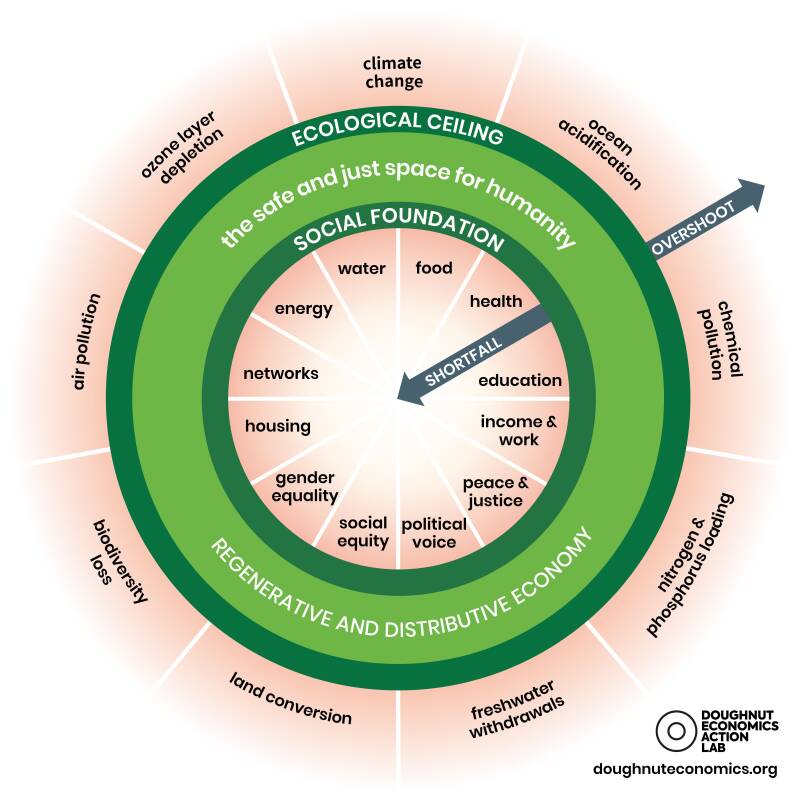
Doughnut Economics is a visual framework for sustainable development that combines the Planetary Boundaries model with human social needs. Developed by British economist Kate Raworth in 2012, it argues that the goal of economic policy should not be endless GDP growth, but rather finding the "sweet spot" where humanity can thrive without destroying the planet.
The model is shaped like a doughnut and consists of two concentric rings:
1. The Inner Ring: The Social Foundation
The inner edge of the doughnut represents the minimum standards for a good life. It is derived directly from the UN Sustainable Development Goals (SDGs). If a society falls inside this inner ring, it is suffering from a shortfall in basic human rights, such as a lack of food, clean water, healthcare, education, housing, or political voice.
2. The Outer Ring: The Ecological Ceiling
The outer edge represents the Planetary Boundaries. If humanity pushes past this outer ring, it causes an overshoot, resulting in catastrophic environmental degradation like climate change, ocean acidification, biodiversity loss, and chemical pollution.
3. The Doughnut's "Meat": The Safe and Just Space
The actual body of the doughnut—the space between the two rings—is the safe and just space for humanity. The goal of Doughnut Economics is to bring all of global society into this space, ensuring no one goes hungry while ensuring we do not destabilise the Earth's life-support systems.
How Cities and Nations are Using It
Instead of just staying a theory, Doughnut Economics has been turned into a practical tool for policymakers through the "City Portrait" methodology:
- Amsterdam: In 2020, Amsterdam became the first major city to officially adopt the Doughnut model to guide its post-pandemic recovery. The city used it to pass laws targeting a 100% circular economy by 2050, introducing strict regulations on construction materials and food waste.
- Copenhagen & Brussels: Both cities have adopted the framework to redesign their urban planning, public procurement rules, and carbon-reduction targets.
- Global Downscaling: Over 40 cities and regions worldwide now use "The Doughnut" to track local metrics. For instance, a city might look at how its local housing policies (Social Foundation) impact global supply-chain emissions or deforestation (Ecological Ceiling).
Case study: Explain the difference between traditional GDP growth and the Doughnut's concept of a "thriving" economy.
The fundamental difference lies in the ultimate goal: traditional economics treats GDP growth as a permanent, exponential curve, whereas Doughnut Economics treats economic health as a dynamic balance.
In traditional economics, a successful country is one where the total monetary value of goods and services constantly rises. In Doughnut Economics, a successful country is one that balances human well-being with planetary limits, regardless of whether GDP goes up or down.
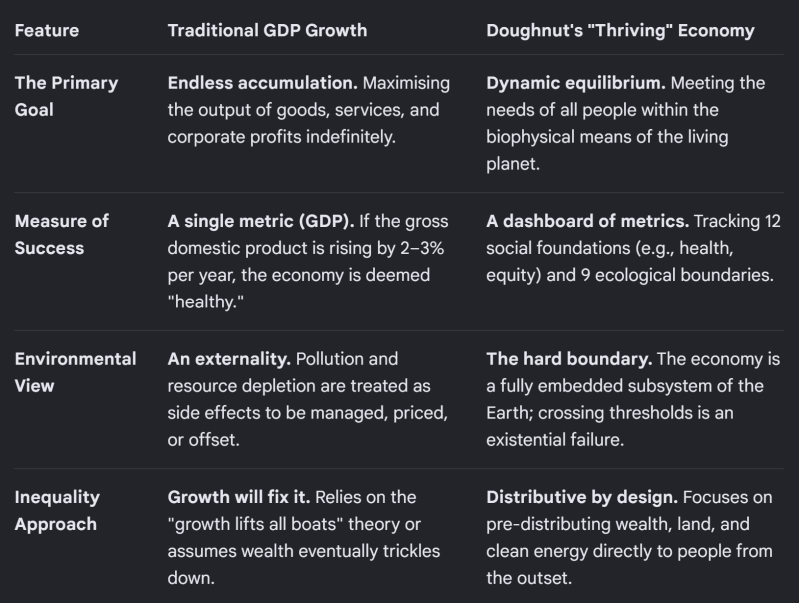
To understand how this shifts real-world policy, the core differences can be broken down across four main dimensions:
1. Structural Growth vs. Agnostic Growth
Traditional capitalism requires structural growth. If a modern GDP-focused economy stops growing, it enters a recession, causing corporate collapses, mass unemployment, and debt crises.
Kate Raworth describes the Doughnut approach as being "growth agnostic." This means designing social and financial systems that allow human beings to thrive, whether GDP happens to be growing, fluctuating, or stabilizing. Instead of an economy that needs to grow, whether or not it makes us thrive, the Doughnut advocates for an economy that makes us thrive, whether or not it grows.
2. Degenerative vs. Regenerative Design
Traditional economic models are inherently degenerative. They use a linear lifecycle: Take materials from the Earth, Make a product, Use it, and Lose it as waste. GDP increases at every step of this extraction and consumption cycle, even if it permanently destroys a freshwater ecosystem or rapidly depletes topsoil.
A thriving Doughnut economy is explicitly regenerative. It replaces the linear model with a circular one. Success is measured by how effectively a city or nation can reuse, repair, and recycle materials. For example, if a factory transitions to a closed-loop system where it generates zero waste and zero carbon emissions, traditional GDP might stagnate because fewer raw materials are bought. However, under the Doughnut model, this is celebrated as a massive systemic success.
3. Divisive vs. Distributive Wealth
GDP measures the total volume of money flowing through an economy, but it does not care who holds it. A country can show booming GDP growth while millions of its citizens lack access to clean water, housing, or healthcare.
The Doughnut model builds distribution directly into its foundational ring. It focuses on sharing value far more equitably among those who co-create it. This means prioritizing laws that support cooperative businesses, community land trusts, and universal basic services, ensuring that the economic "meat" of the doughnut is evenly shared rather than concentrated at the top.