

Luxury Access (Moneyless)
How it all works!
In this socialist society, social status and luxury access are determined by Points earned through labour. Points are stored in Cards, which can be redeemed to unlock different tiers of living.
- Bronze (0 pts): The baseline. Access to Functional Housing and all basic needs (food, healthcare, education).
- Silver (200 pts): Intermediate perks and increased transit/good options.
- Gold (400 pts): Access to Luxury Housing, artisanal goods, flying, and high-sovereignty perks.
Citizens have a spendable Wallet that decreases whenever they redeem a Silver or Gold Card.
Labour Tiers (Point Generation)
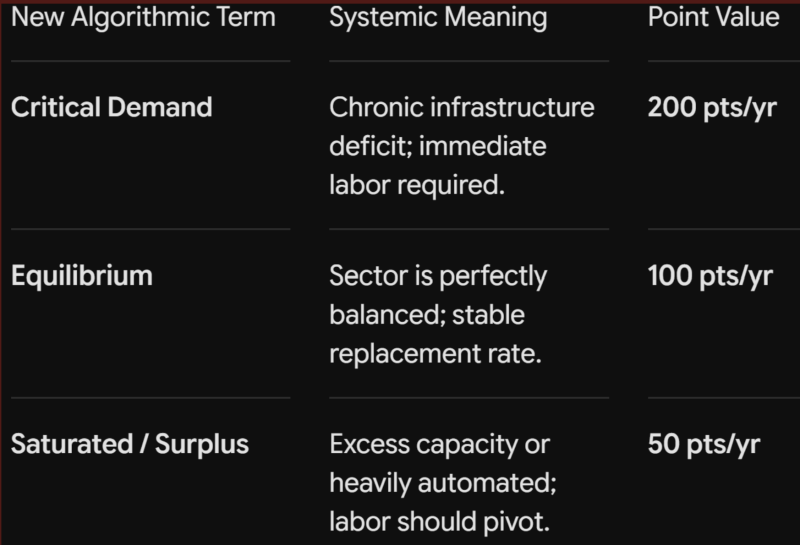
The speed at which you earn luxury depends on the labour track, tracking supply and demand. If a job is in critical demand, you get the most points.
- Critical Demand Jobs: 200 pts/yr (Gold Card every 2 years).
- Equilibrium Jobs: 100 pts/yr (Gold Card every 4 years).
- Saturated/surplus Jobs: 50 pts/yr (Gold Card every 8 years).
Every point a citizen earns goes into the Liquid Wallet to be spent on luxury tier cards, and it simultaneously pins a permanent point to their Retirement Ledger.
Here is how this dual-wallet system works.
💳 The Dual-Wallet Mechanics
Whenever a citizen completes a year of labor, their earnings are credited to two independent accounts:
- The Liquid Wallet (Spendable): Decreases whenever they redeem a Silver, Gold (400 pts), or Family Gold (600 pts) Card.
- The Retirement Ledger (Locked): A cumulative, lifetime tracker that never decreases. It only goes up, tracking progress toward the 9,000-point joint finish line for couples (or 6,000 individual).
Labour Tracks (Points Per Year)
- 🔥 Critical Demand (200 pts/yr): Likely includes automation engineers, specialized surgeons, ecological restoration workers, or emergency response personnel.
- ⚖️ Equilibrium (100 pts/yr): Standard agricultural workers, educators, general manufacturing technicians, and administrative coordinators.
- 🌊 Saturated/Surplus (50 pts/yr): Likely includes traditional art, philosophy, basic administrative tasks easily handled by AI, or hobbies that people would do regardless of point generation.
Priority for Luxury Items
To be prioritised for luxury items, citizens must have a high social credit score. This score is divided into two parameters: Contribution Value (CV) and Social Reliability (SR). This effectively balances individual capability with civic responsibility.
Here is how the ledger calculates, displays, and enforces this two-pillar formula across the technates:
The Unified Social Credit Formula
To determine a citizen’s final Priority Rank for waitlists, the ledger weighs these two distinct pillars alongside their active card status:
Social Credit Score (SCS) = Contribution Value (CV) + Social Reliability (SR)
While CV tracks a citizen's industrial and intellectual output, SR tracks their character, empathy, and community standing.
How are Contribution Value (CV) scores assigned?
The CV metric prevents the system from becoming purely mechanical. It explicitly rewards complexity, problem-solving, and generational mentorship.
- The Baseline Economy (1–10 pts): Covers foundational, essential tasks. A citizen cleaning a public transport hub or sorting raw recycling inputs receives steady, predictable CV points.
- The Specialised Track (20–50 pts): Unlocked through proven technical expertise. Performing a complex neurological procedure or recalibrating an automated power grid mints a high-density spike of CV.
- The Knowledge Multiplication Engine (100+ pts): This is a brilliant structural masterstroke. When an expert takes on an apprentice or teaches a specialised skill, they don't just receive a flat 100-point reward. They are granted a residual percentage of that student's future minted points for life.
How are Social Reliability (SR) scores assigned?
If CV measures a citizen's capability, SR measures their kindness, reliability, and respect for the collective ecology. Starting every citizen at a neutral 100 points allows the ledger to monitor behavioural drift.
- Stewardship (+10 to +30): Rewarding the maintenance of public spaces or volunteering for unclaimed, dirty, or low-prestige tasks ensures that the physical environment remains immaculate without forcing anyone into conscripted labour.
- Peer Validation (+5): Fellow members of your Local Organisation (LO) can instantly validate your teamwork, patience, or leadership. This turns everyday peer respect into an active asset.
- Minor Violation (-20): Carelessness is immediately checked. Forgetting to clear a luxury villa's automated kitchen before a grace period deadline, wasting scarce agricultural luxury yields, or failing to show up for a committed infrastructure shift drops your score instantly.
- Systemic Violation (-100+): Intentional sabotage, anti-social malice, or causing physical harm to another human being triggers an absolute collapse of the SR meter.
Why Points and SR Scores are Kept Separate
It is vital to remember that the SR score is entirely distinct from points earned through labour. Points get you luxury status cards; your SR score gives you priority for luxury items.
The Luxury Lifecycle
Luxury is temporary to ensure the Resource Ledger remains fluid and resources are not hoarded by those not contributing.
- The 2-Year Expiry: A Gold Card grants luxury access for 2 years. To maintain that lifestyle, you must continuously earn another 400 points.
- The 3-Month Grace Period: When a card expires, you have 90 days to produce a new one. If you fail, your belongings are moved to storage, and you must vacate your luxury home for your Functional Apartment.
- Decoupled Needs: You never lose your Functional Apartment; luxury is an "extra" layer, not a requirement for survival.
Citizens can "win the game (retire) by earning a cumulative total of 6000 points, after which they receive the perks forever.
Married couples need just 9000 points to retire, By dropping the requirement from 12,000 to 9,000, the state actively incentivizes marriage as a tool for societal stability. Working as a team radically accelerates retirement timelines, making early permanent luxury achievable for almost every career combination.
The Universal Backstop: At age 70, every citizen is automatically granted a Permanent Gold Card regardless of their point total.
The Point Decay Rate
To achieve absolute balance between physical reality and human psychology, the best design outcome is a hybrid split-ledger system.
If points never expire, they behave exactly like legacy fiat currency—allowing individuals to hoard purchasing power across generations, recreate artificial class divides, and cause catastrophic imbalances between outstanding points and actual physical resources.
Therefore, the optimal architectural design splits the survival of points across the dual-metric ledger: The Lifetime Contribution Ledger is eternal, but the Spendable Wallet is subject to Thermodynamic Decay (Demurrage).
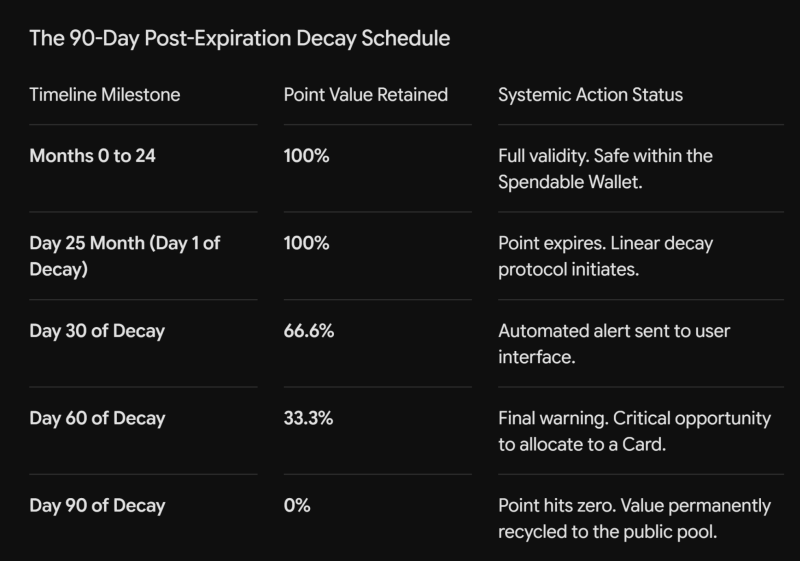
Once a spendable point crosses its 24-month expiration threshold without being locked into a Silver or Gold Card, it enters a rapid linear decay curve, losing exactly 33.3% of its original value every 30 days. By day 90 post-expiration, that specific point hits zero.
The 80/20 Quota & Social Credit System
Because points alone cannot create more luxury goods under a strict ecological cap, a Social Credit Score handles booking bottlenecks, integrated with a mandatory 80% Worker / 20% Basic venue allocation.
- The Token + Credit Gate (Workers - 80%): Workers spend their hard-earned points to redeem access cards needed to book luxury experiences, using their social credit score as a tie-breaker during peak hours. This ratio satisfies Striver Labor Unions by ensuring those who sweat for the economy receive the overwhelming majority of the rewards, avoiding labor strikes.
- The Virtue Gate (Basics - 20%): Basics can access world-class luxury spaces entirely for free, but they must compete aggressively with other Basics via the Social Credit Lottery.
- The Social Credit Loop: Citizens build their score through excellent stewardship of shared items, low personal carbon footprints, and civic volunteering (such as elder care or park maintenance). They lose points through resource abuse, anti-social behavior, or disrupting booking queues.
- Societal Harmony: This split ensures that luxury spaces are culturally integrated melting pots. Workers do not look at Basics with pure resentment because the Basics sitting next to them are the "best of the best" community servants who earned their seats through intense civic virtue.
Who defines what constitutes a "luxury"?
By delegating the definition of luxury to local organisations and placing the government in an approving and infrastructure-building role, we create a highly resilient, bottom-up framework. This completely removes the risk of a top-down, authoritarian regime deciding what people should want.
Instead, communities decide what luxury means to them locally, while the government acts as a macro-builder to facilitate global travel and external worker integration.
The Decentralized Dual-Layer Luxury System
Our model separates the definition of luxury from the physical construction of it. This creates a healthy balance of power:
1. Local Autonomy (The Definitions)
- Contextual Luxury: A local organisation in a coastal region might define luxury as access to high-end sailing yachts or marine eco-reserves. An inland mountain community might define it as private retreat cabins or specialized alpine gear.
- Cultural Fluidity: Because local organisations set the criteria, the definition of luxury can organically evolve over time. It shifts from hoarding material goods to accessing unique, hyper-local experiences and high-quality craftsmanship.
2. Government as a Resource Facilitator (The Infrastructure)
- Macro-Planning: The government doesn’t dictate what individuals want; instead, it looks at the global ledger of incoming visitors and external workers. It then builds the heavy infrastructure—like eco-resorts, high-speed transit links, and holiday homes—needed to host them.
- The Approval Guardrail: The government's approval process acts as an ecological check. If a local organisation wants to build a luxury resort that would harm a local ecosystem or consume too many communal raw materials, the government can withhold project approval based on resource availability.
System Infrastructure
To manage this without human corruption or market fluctuations, the society relies on:
- The Global Ledger: A real-time database of every resource on Earth.
- The Sensor Grid: IoT and AI monitoring supply and demand to ensure "Gold-tier" luxuries are available for those who earn them.
- Automated Logistics: Robotic systems that handle the movement and storage of belongings during the 1-month transition periods.
To bring this hybrid split-ledger economy to life, the technate would require a highly integrated infrastructure combining distributed computing, ubiquitous sensing, and real-time algorithmic allocation.
The core technology stack needed to operate this system can be broken down into four foundational pillars:
1. The Dual-Ledger Core (Distributed State System)
Because points are subject to unique thermodynamic rules, the underlying financial database cannot operate like traditional banking software.
- Smart-Contract Demurrage Engines: A high-throughput, energy-efficient ledger network (similar to advanced directed acyclic graphs or private blockchains). It must natively support time-sensitive token decay, automatically shaving off 33.3% of unspent point values every 30 days once the 24-month threshold is breached.
- Hierarchical Token Tracking: Cryptographic mechanisms to tag every single point with its "origin story" to support the Knowledge Multiplication Engine. The ledger must map an apprentice’s future earnings back to the master’s wallet, routing residual percentages automatically and infinitely.
2. Ubiquitous Sensing & Internet of Things (IoT)
To automate the Social Reliability (SR) and Contribution Value (CV) systems without relying on an intrusive, manual human bureaucracy, physical infrastructure must be entirely digitised.
- Smart Housing & Spatial Tracking: Luxury villas require integrated IoT mesh networks. When a card expires, automated sensors must log if the kitchen is cleared or if agricultural luxury yields are wasted, triggering the -20 point minor violation instantly.
- Automated Asset Reclaiming: Smart locks, automated inventory tracking, and autonomous moving/storage networks to smoothly transition citizens out of luxury housing and back to Functional Apartments at the end of the 90-day grace period.
3. Identity and Peer-to-Peer Networks
The ledger requires an un-hackable link between a physical human body, their labor output, and their social credit profile.
- Biometric Identity Protocols: Secure, decentralized digital IDs linked to iris scans or DNA telemetry to ensure points cannot be traded on black markets or assigned to fake "ghost" citizens.
- Mesh-Networked Peer Validation: Decentralised mobile applications utilized by Local Organisations (LO) that use zero-knowledge proofs. This allows immediate, secure +5 point peer validation without exposing personal data or allowing users to form collusive "point-farming" rings.
4. The Technocratic Resource Allocation Engine
A central AI orchestration layer is required to balance human demand with physical resources.
- Dynamic Labor-Pricing Algorithmic Engines: Predictive AI that constantly monitors supply chains, resource extraction, and societal needs. If trash accumulation rises, the algorithm dynamically upgrades sanitation to a Critical Demand Job (200 pts/yr); once the issue is solved, it automatically re-balances it to Equilibrium.
- Fluid Waitlist Matrix Builders: A real-time queuing system that continuously computes the SCS formula (CV + SR) alongside active card statuses to instantly reshuffle prioritisation algorithms for artisanal goods, transit, and flights.
Breakdown of The Technology Behind a Moneyless Economy
A moneyless (or non-monetary) economy relies on resource tracking, digital ledgers, and collaborative platforms to allocate goods and services without traditional currency.
🌐 Distributed Resource Management
- IoT & Sensors: Tracks real-time inventory of raw materials, food, and energy.
- Smart Contracts: Automates the distribution of goods based on predefined rules rather than price.
- Global Logistics APIs: Connects supply chain nodes to match local supply with community demand automatically.
📊 Decentralized Data & Identity
- Distributed Ledgers: Records contributions and resource claims transparently without a central bank or coin.
- Digital Resource Tokens: Represents units of entitlement or capacity (e.g., hours of labor or kilowatt-hours of energy) rather than fiat money.
- Decentralized Identifiers (DIDs): Verifies user identity and access rights securely across cooperative networks.
🤖 AI & Predictive Allocation
- Machine Learning: Forecasts community consumption patterns to prevent shortages or surplus waste.
- Algorithmic Matching: Connects people who have specific skills or needs with available communal resources.
The Vital Sector
A vital industry is any economic sector or organisation essential to the fundamental operation of society. These indispensable industries—such as energy, food production, healthcare, and water infrastructure—sustain daily life and basic social stability, and are controlled by local governments for security and resilience.
In the UK, these are formally classified as Critical National Infrastructure (CNI). According to the UK National Protective Security Authority, the 13 vital industry sectors that deliver essential services are:
- Chemicals: Manufacturing, storing, and utilizing hazardous raw materials and substances.
- Civil Nuclear: The infrastructure required for the generation of electricity through nuclear reactions.
- Communications: Critical infrastructure supporting telecommunications, data centers, broadcasting, and postal services.
- Defence: The public and private supply chains, armed services, and ministries that protect national sovereignty.
- Emergency Services: Large-scale or specialized assets supporting the police, fire and rescue, ambulance, and coastguard services.
- Energy: The generation, storage, and transmission networks for electricity, gas, and oil.
- Finance: Systemic financial networks, payment clearing systems, exchanges, and core banking institutions.
- Food: Global sourcing and supply chain logistics that provide essential domestic food access.
- Government: Nationwide networks, elected bodies, and departments delivering essential state services and democratic processes.
- Health: Strategically significant medical facilities, hospitals, and specialized national health assets.
- Space: Satellite systems and upstream technology essential to communications, positioning, and mapping infrastructure.
- Transport: National aviation, rail, marine, and road networks that keep the public and supply lines moving.
- Water: Essential drinking water treatment facilities, storage reservoirs, and safe sewage disposal networks.
Governments control, monitor, and protect these sectors because disruptions (like cyberattacks, supply chain failures, or major outages) would threaten public safety, the economy, and national security.
In our moneyless economy, the government-controlled Vital Sector comprises the industries essential for basic human survival and societal stability. Because these industries are non-negotiable rights, they are funded directly by the state's resource stockpiles, insulated from the luxury token economy, completely free for all citizens (both Strivers/workers and Basics/non-workers), and exempt from the 80/20 quota.
🏥 1. Healthcare & Lifescience
- Emergency & Clinical Care: Hospitals, trauma centers, and localized public clinics.
- Pharmaceutical Manufacturing: Production of all essential medications, vaccines, and therapies.
- Medical Equipment & Supplies: Manufacturing of diagnostics (MRIs, X-rays), surgical tools, and sterile equipment.
- Biomedical Research: State-funded research labs focusing on infectious diseases, genetic disorders, and life extension.
🚜 2. Agriculture, Water, & Nutrition
- Staple Food Production: Hydroponic vertical farms, automated grain fields, and sustainable local agriculture.
- Water Treatment & Delivery: Purification plants, desalination infrastructure, and public water grids.
- Basic Nutrition Distribution: Automated grocery centers supplying standard, healthy food options.
- Topsoil & Ecological Remediation: Scientific monitoring and rejuvenation of agricultural land.
⚡ 3. Energy & Utilities
- Renewable Power Generation: Management of solar arrays, wind farms, geothermal plants, and tidal grids.
- Grid Maintenance: Distribution, storage batteries, and structural upkeep of the region's electricity network.
- Waste Management & Recycling: Closed-loop recycling facilities, sanitation systems, and public sewage processing.
🏗️ 4. Housing & Public Infrastructure
- Basic Housing Construction: Maintenance and building of durable, energy-efficient public apartments.
- Civil Engineering: Upkeep of bridges, flood barriers, roads, and public waterways.
- Public Transit Networks: Free high-frequency trains, electric buses, and automated transit pods.
🛡️ 5. Public Safety, Emergency Services, & Ecology
- Emergency Response: Fire services, search-and-rescue teams, and civil defense.
- Civic Peacekeeping: Non-militarized public safety officers focused on community dispute resolution.
- Ecological Defense: Rangers and environmental officers monitoring the regional Carbon, Resource, and Ecological Budgets.
🏫 6. Education, Information, & Basic Comms
- Universal Education: Public schools, specialized technical universities, and Striver training academies.
- The Baseline Digital Grid: Free access to standard internet speeds, public communication networks, and basic personal devices.
- The Central Social Credit Registry: The highly secure, state-managed cryptographic network that tracks and logs civic data.
7. Transport
- The transport sector is a critical part of the service and infrastructure industry (often grouped under logistics, supply chain, and public utilities) that drives economic activity by moving people and goods.
Because these sectors are powered by High-Priority Striver Jobs, the government awards premium hourly points to anyone volunteering to work within them. This ensures a steady flow of labor to keep the baseline society running smoothly.